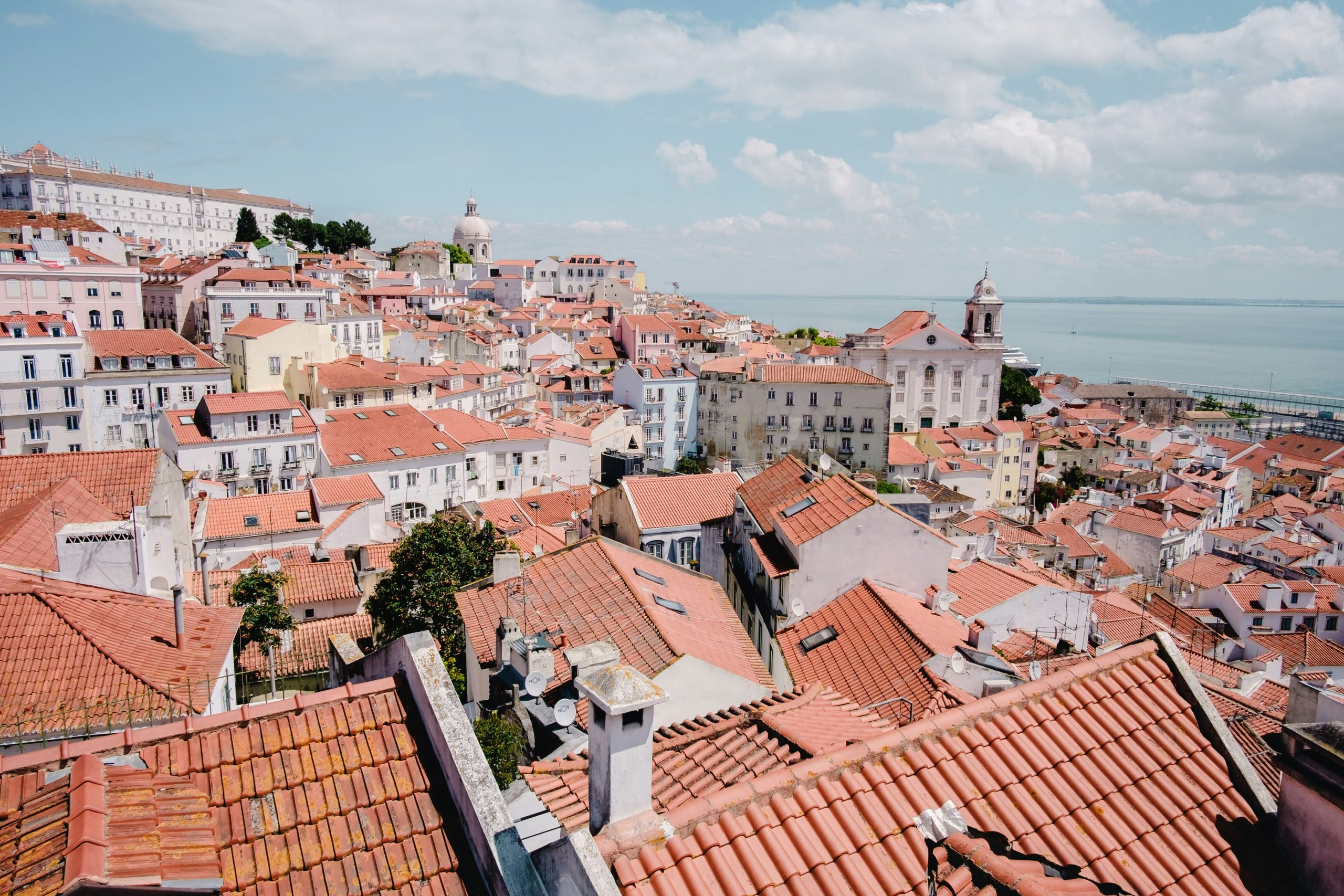
Stand on the corner of Rua de São João da Praça and Largo do Marquês do Lavradio at dusk, and the building that houses Casagrand Lisboa seems to lean gently toward the river, as if it has spent centuries listening to it. The Tagus catches the last light in shades of copper and blue, a tram bell sounds somewhere below in Alfama’s tangle of streets, and the pale stone facade holds its ground the way it has held it for generation after generation. This is not a building that was built to impress. It is a building that has simply lived, through more chapters than most guests realize when they first turn the key.
A Corner of the Oldest Neighbourhood in Lisbon
Alfama is Lisbon’s oldest neighbourhood, older than the city’s grand boulevards, older than the earthquake that reshaped so much of the capital in 1755. Its name comes from the Arabic al-hamma, meaning hot springs, a trace of the centuries when Moorish Lisbon stretched along this hillside between the castle and the river. Where the Marquês de Pombal rebuilt the Baixa in strict, rational grids after the earthquake, Alfama simply kept going: narrow lanes that fold back on themselves, staircases worn smooth by feet, laundry lines strung between windows that have faced each other for hundreds of years. It is one of the reasons Alfama looks and feels the way it does today. When the 1755 earthquake devastated much of Lisbon, many of Alfama’s buildings survived relatively intact, and the neighbourhood carried on largely as it had before, through periods of decline and later revival, without ever losing its own particular rhythm. It is, as more than one Lisboeta has put it, the real soul of the city, a place where history was never written down so much as sung, cooked, and carried from one generation to the next.
Number 83 sits right at the edge of this old fabric, on a corner that has watched Alfama’s daily rhythms unfold for longer than any living resident can remember. It has always belonged to the neighbourhood’s rhythm rather than standing apart from it, and that sense of belonging is part of what Casagrand Lisboa’s restoration was so careful to preserve.
Step outside the front door today, and the same rhythm is still there to join. The iconic Tram 28 rattles past within a few minutes’ walk, carrying visitors and locals alike along one of the most photographed routes in the city. Lisbon’s cathedral, the Sé, is close enough to reach on foot, its Romanesque towers rising just above the rooftops. Miradouro de Santa Luzia, one of Alfama’s most romantic viewpoints, sits a short climb away, framed by bougainvillea and blue and white tile panels of its own, and the Museu do Fado, dedicated to the very musical tradition this building once hosted, is within easy walking distance too. None of this is incidental to the building’s story. Alfama’s geography, its steep lanes, its closeness to the water, its distance from the wide boulevards built after 1755, is exactly what allowed a building like this one to keep so many of its original layers intact.
If you want to dive deeper into everything the neighbourhood has to offer before your trip, Staying in Alfama: The Complete Guide to Staying in Alfama: What Luxury Travellers Need to Know, covers viewpoints, recommendations, and how to get around the area.

A Building With Many Lives
What makes this address unusual is not simply its age, but the sheer range of lives it has lived inside those walls. Over the course of a century and more, the building has served as a school, as a sports club, as a fado house, and as a jazz club. Four entirely different rhythms of life, four different kinds of gathering, all inside the same stone shell.
Picture it for a moment: children’s voices reciting lessons in a classroom that might now be someone’s living room. A sports club where neighbours came together after long working days, the kind of modest, communal athletic clubs that once anchored so many of Lisbon’s older neighbourhoods. Later, the unmistakable sound of a fado house, that particular hush before a fadista begins to sing, followed by the ache of a voice given over entirely to saudade. And later still, in the swing and improvisation of a jazz club, a different kind of Lisbon entirely, cosmopolitan and forward-looking, filling the same rooms with an entirely different music.
It is a rare thing for a single building to hold that much range of human experience, and rarer still for a place to be able to say, with real documentation behind it, that it once was home to the guitarrista of Amália Rodrigues, the singer whose voice came to define fado for the entire twentieth century and beyond. Amália Rodrigues never needed an introduction in Lisbon, and she barely needs one anywhere else in the world today. Her guitarrista, the musician responsible for the guitarra portuguesa’s silvery, weeping lines beneath her voice, lived within these same walls. It is worth being precise here: this is not a claim that Amália herself lived at number 83, but that the man who shaped the sound behind her voice called this building home. That distinction matters, and it is exactly the kind of detail that makes the building’s history feel earned rather than embellished. Fado was not decoration here. It was daily life, played out by someone who helped shape how an entire nation would come to hear its own most famous singer.

Image from Museu do Fado, www.museudofado.pt
Thirteen Thousand, Five Hundred Tiles
If the building’s musical history speaks to what happened inside these walls, its azulejos speak to what has always been visible on the surface. Portugal’s tradition of hand-painted tiles stretches back centuries, brought first by Moorish craftsmen and then reinvented again and again by Portuguese ceramicists, until the azulejo became something close to a national language, telling stories on church facades, train stations, and ordinary apartment buildings alike. Few decorative traditions manage to be both utterly practical, tiles were prized for keeping interiors cool through Lisbon’s long summers, and quietly artistic at the same time, and Alfama’s buildings are where that dual purpose is easiest to see up close.
Casagrand Lisboa’s building holds more than 13,500 original hand-painted tiles, a number that becomes almost impossible to picture until you are standing in a stairwell or a bedroom lined with them, tile after tile, each one placed by hand long before anyone could have imagined the building’s later chapters as a fado house or a jazz club, let alone as a place where today’s travellers would come to sleep. During the building’s restoration, some of these historic tile panels, classified for their heritage value, were carefully removed, catalogued, and reinstated exactly where they belonged, patient work that protected two centuries of craftsmanship rather than replacing it with something easier or newer.
Among the discoveries made during that restoration was a small but telling detail: a tile panel bearing the date 1760, a quiet signature left behind by whoever commissioned it, suggesting a history for this corner of Alfama that reaches back further than the building’s more recent lives as a school or a fado house. Nobody claims to know everything the building has seen since that date. But a single dated tile, uncovered by chance during careful restoration work, is exactly the kind of detail that turns a renovation project into an act of stewardship.
The restoration team did not rely on memory alone to piece this history together. Records held at the Arquivo Municipal de Lisboa, the city’s municipal archive, include nineteenth-century topographic maps and photographs of the wider Alfama neighbourhood, material that documents how this part of the city has changed, and in some ways stayed the same, over the past two centuries. That kind of documentation is rare for a residential building of this age, and it gave the restoration a genuine record to draw on rather than guesswork alone.
A Restoration Done With Patience
None of this history survived by accident. The building’s transformation into Casagrand Lisboa was the work of Pujolinvest, a company with close to sixty years of experience in urban regeneration and heritage restoration across Lisbon and beyond. Their approach to a building like this one was never going to be a matter of stripping it down and starting over. It meant working tile by tile, deciding what could be gently repaired rather than replaced, and only then layering in the comfort that today’s travellers expect. That same care carries through into daily life at Casagrand Lisboa today, where a resident concierge team, often mentioned by name in guest reviews, treats the building’s history as something to be shared rather than simply preserved behind glass.
The result is a building that does not pretend to be new, and does not ask guests to sacrifice comfort for character either. High ceilings that once echoed with schoolchildren’s lessons now shelter a quiet reading corner. A room that may once have held the low murmur of a fado audience now holds a family’s suitcases and the soft light of early morning over the Tagus. The building has simply picked up a new chapter, the way it always has.
Walk through any of the thirteen apartments today and that layering of old and new is easy to feel. The building’s 13,500 original tiles sit alongside a restoration that was carried out room by room, rather than through a single uniform renovation. Nothing here is staged to look old. It simply is old, cared for rather than concealed, and that honesty is part of what makes the building feel less like a hotel and more like a home that happens to remember everything.

Staying Inside the Story
To stay at Casagrand Lisboa is to sleep inside a building that has already been a school, a sports club, a fado house, and a jazz club, a building whose tiles were painted by hand more than two centuries ago and whose history survived an earthquake that reshaped the rest of the city. It is not a hotel dressed up to look historic. It is history, genuinely lived in, now offered as a home for a few nights or a few weeks.
Alfama itself asks the same thing of every visitor that this building always has: slow down, notice the details, let the neighbourhood’s rhythm set the pace rather than the other way around. From the terraces and windows of Casagrand Lisboa, that rhythm is close enough to touch, the Tagus catching the light exactly as it has for the fadistas, the schoolchildren, and the jazz musicians who came before.
Live this story in the first person. Book your stay at Casagrand Lisboa and spend your nights inside a piece of Alfama’s living history.